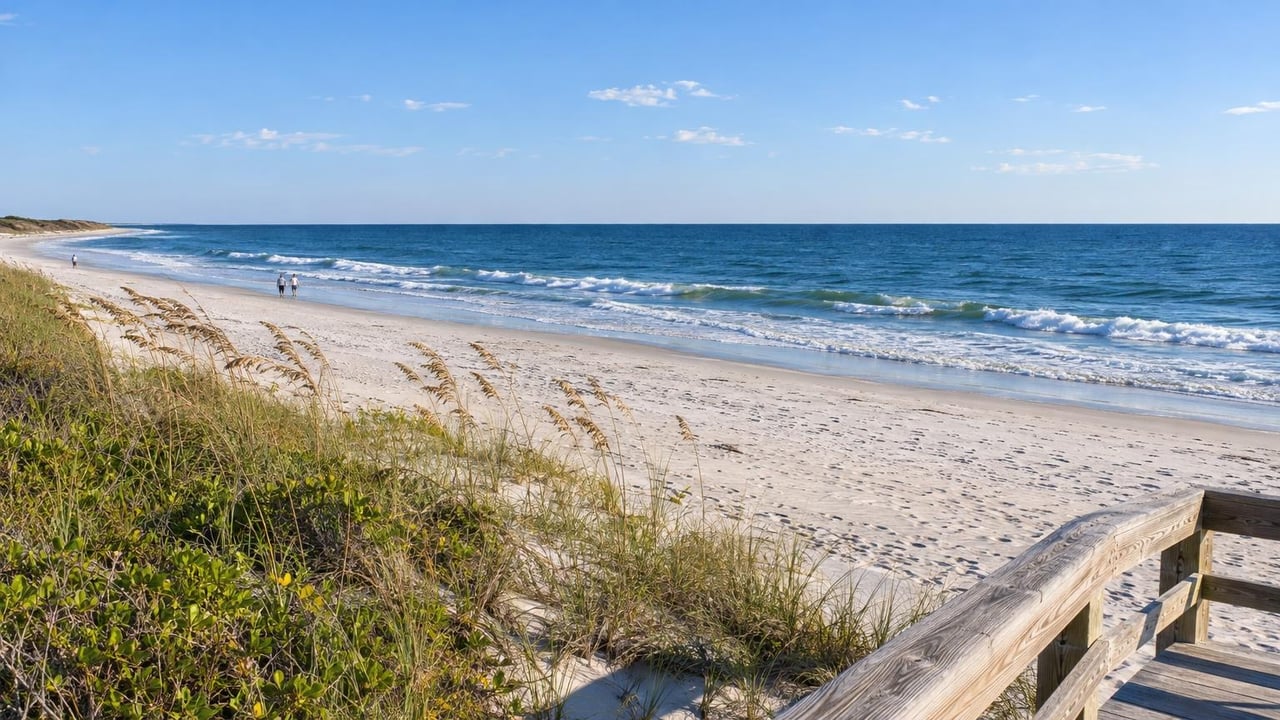
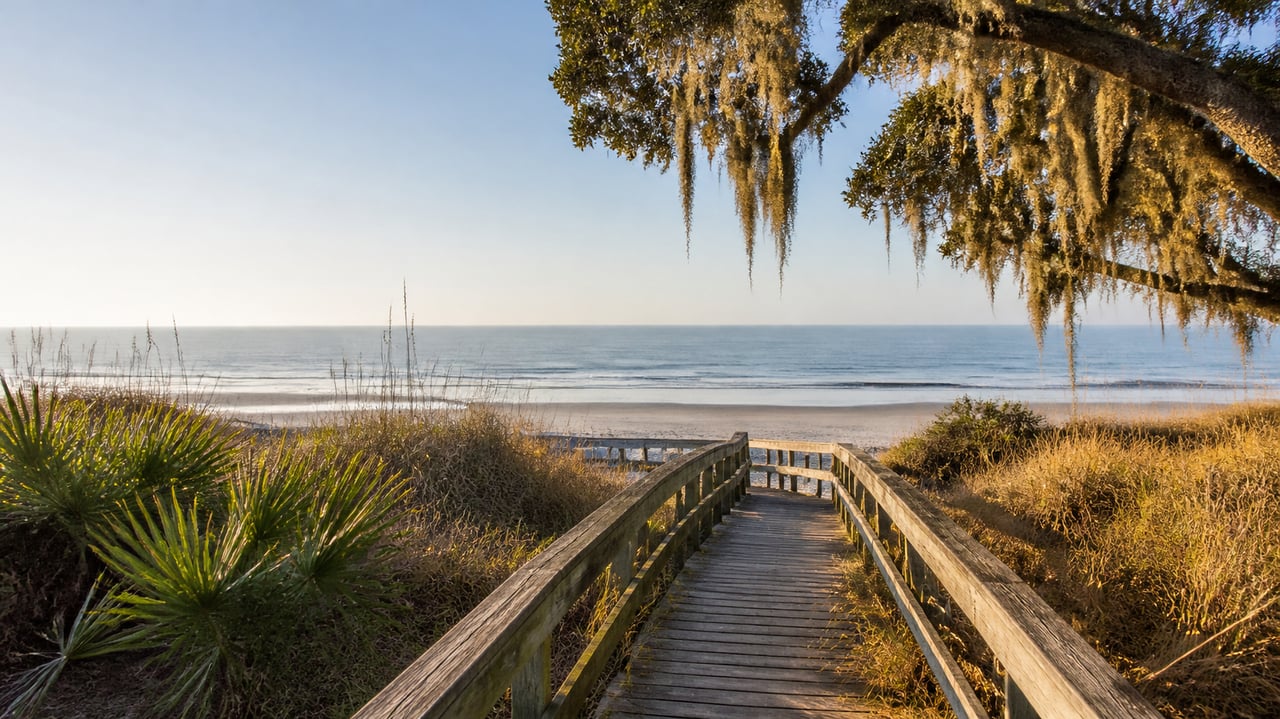
Right Whale Calving Season, Seen From Amelia Island Plantation's Beach
On January 16, 2026, a survey team found a right whale named Magic with her calf about 10.8 nautical miles east of Amelia Island, according to the New England Aquarium's 2025-2026 mother and calf list. Almost four weeks later, on February 12, Magic and her calf could be seen from a private property in Ponte Vedra. A member of the public reported the sighting, and a Marineland Right Whale Project team responded and confirmed the pair. That pair shows how the season tends to go for anyone on Amelia Island Plantation. The whales go past the south end every winter. Off Amelia they are usually too far out to see from shore, and the sightings close to the beach have come farther down the coast.
The 2026-27 calving season is now under way. Here is what the records show about how close these whales come to the Plantation's stretch of beach.
NOAA Fisheries says the right whale calving and field season runs from mid-November to mid-April. As of its most recent update, researchers had identified one calf this season. On November 10, 2026, members of the public reported a mother and calf to NOAA's hotline about 11 nautical miles east of St. Augustine Inlet. The mother was Curlew, catalog #4190. She is 16 years old and this is her first calf. She was named for a scar on her back shaped like the curved bill of a curlew, which is a shorebird.
A second first-time mother showed up nine days later. The New England Aquarium's 2026-2027 page reports that Snail, catalog #4050, was seen with her first known calf off Virginia on November 19, near a busy shipping channel. Virginia is a long way north of Nassau Sound. Even so, mothers that calve outside the Southeast are part of the same population that uses these waters. NOAA calls the Southeast the only known area where right whales regularly give birth and nurse their young.
Each calf counts because the population is so small. NOAA estimates about 380 North Atlantic right whales are left, and about 70 of them are reproductively active females. In the 2025-26 season, NOAA's tally at the end of April was 23 calves, the most since 2009. On September 25, a whale named Silt was seen in Canada with a calf that researchers believe was born during that season. The Current reported that the late find raised last season's total to 24.
The best guide to what this winter could look like from the south end is where the mothers and calves were actually logged off Amelia Island and the St. Marys entrance. The table below covers the 2025-26 season and is drawn from the New England Aquarium's mother and calf records.
| Date | Mother and calf | Reported position |
|---|---|---|
| December 3, 2025 | Millipede and calf | About 4.5 nautical miles east of the St. Marys River entrance |
| December 23, 2025 | Bermuda and calf | About 11 nautical miles off Amelia Island |
| January 1, 2026 | Boomerang and calf | About 7.5 nautical miles east of the St. Marys River entrance |
| January 5, 2026 | Skittle and calf | About 16 nautical miles off Fernandina Beach |
| January 16, 2026 | Magic and calf | About 10.8 nautical miles east of Amelia Island |
The season before followed the same pattern. Amelia Island Whale Ambassadors' 2024-25 updates put Minus One and her calf about 6 miles off Amelia Island on December 9, 2024. Grand Teton and her calf were 11.1 miles east of the island on January 16, 2025, and Check Mark and her calf were 9 miles off the next day. Cashew and her calf were about 7 miles off Nassau Sound on February 5, 2025.
Over two seasons, the closest logged pair was Millipede at about 4.5 nautical miles off the river entrance. Most of the others were 6 to 16 miles out. These are survey positions, and none of them is tied to a particular beach access on the island. At those distances, the pairs have been passing well beyond what you can see from a dune walkover.
The close-to-shore sightings in the recent records come from St. Johns County. Minus One is a good example. After her offshore sightings near Amelia Island and Ponte Vedra, volunteers with the Marineland Right Whale Project reported her and her calf close to shore at South Ponte Vedra on January 5, 2025. The project called it their first sighting of the pair close to shore. On February 24, 2025, a team watching from Crescent Beach recorded a calf breaching with its mother nearby. On January 11, 2026, Callosity Back and her calf were seen off Mickler's Landing in Ponte Vedra.
Part of the reason is who is doing the watching. Marineland's shore program covers the coast from Ponte Vedra Beach to Ponce Inlet. Its mobile teams work from set lookout points with binoculars, and stationary teams watch from oceanfront communities. Organized spotters along that stretch look at the water every day of the season. Amelia Island has its own group that trains spotters, covered further down.
A right whale is easy to tell apart once you know three things. The Marineland Right Whale Project lists a V-shaped blow, no dorsal fin, and rough patches of skin on the head called callosities. A broad dark back with no fin is worth a second look.
Calm water and good light help. NOAA notes that bad weather, rough seas and low light make right whales harder to find from the air or the water. The Current's report on Curlew's calf also linked calm seas to seeing a whale. If you plan to scan the water from the south end this winter, a flat morning with no wind is the best time to bring binoculars.
The phone number is worth saving now. NOAA's Southeast hotline for right whale sightings is 877-WHALE-HELP, which is 877-942-5343. Boaters can also report on VHF Channel 16, and NOAA's page on helping right whales lists both. Curlew's calf, the first of this season, was found because members of the public called that hotline.
Amelia Island Whale Ambassadors trains people to recognize right whales from the beach. People who complete the training qualify for alerts from the Right Whale Sighting Network, so a trained resident hears when a pair has been reported nearby. Kristy Smith is the group's volunteer coordinator, and Theresa Hartz is the contact for community presentations. The group has spoken on the south end before. Its presentation list includes a talk at Amelia Island Plantation on March 23, 2023, attended by 100 people.
This fall the group's calendar was full. Right Whale Week ran from October 30 to November 8. The Right Whale Festival was scheduled at Main Beach Park on November 7 and 8, and a sighting training was set for November 9 at the Courtyard by Marriott Amelia Island. The group's "Right Whales of Amelia Island" exhibit is on display at Clearwater Marine Aquarium through January 2027, so the island's whale story is reaching the Gulf Coast this winter.
For a Plantation resident, the alert network is the practical way to follow the season. The pairs move along the coast for weeks. Magic went from 10.8 nautical miles off Amelia in mid-January to being visible from a Ponte Vedra property in mid-February. An alert that a pair is passing close to Fernandina or Nassau Sound gives you the information the sighting records can't.
While the whales stay offshore, the beach at the island's south tip still has plenty of wildlife from December through March. Amelia Island State Park, just past the Plantation, lists piping plovers, Wilson's plovers, willets, black skimmers and least terns feeding or resting on its shoreline. It notes that bald eagles can be seen in winter and early spring. The Florida Birding Trail suggests the bridge catwalk and pier for views of the Nassau Sound sandbars and bird islands.
By spring the birds change. FWC's Amelia Island Critical Wildlife Area covers 250 acres of beach along the state park, and its focal species are least terns and Wilson's plovers, which nest there.
For a set date, the Amelia Island Bird Club lists its Christmas Bird Count for Saturday, December 26, 2026, starting at 8 a.m. Details go out to members by email.
The sand under all of this is also recent. Florida DEP's August 2026 statewide beach plan records a March 2025 placement of about 565,352 cubic yards of sand at the state park end of the South Amelia project. The next full nourishment is scheduled for 2030 or 2031. The same plan describes Nassau Sound as an undeveloped inlet whose shoals shift back and forth, building up and wearing away the ends of Amelia and Little Talbot islands.
For more about the south end, our Amelia Island Plantation neighborhood page and our guide to Amelia Island in winter cover the rest of the season.
If you have questions about the oceanfront on the south end, including which walkovers face Nassau Sound and which buildings look out over open ocean, Jon Bell knows this stretch of beach well and is glad to talk it through. Let's Connect.
lifestyle
What to see, do and eat in Fernandina Beach and around the island.
buying
Direct hurricane hits here are rare, but surge, flood zones and insurance decide what a home really costs. Here is how I walk buyers through it.
Buying
What the Florida homestead exemption and Save Our Homes portability do for you, and how Amendment 3 changes the numbers starting in 2027.
lifestyle
Every paved trail, bike lane and park loop on Amelia Island, the 2026 e-bike rules, and a route map you can take with you.
lifestyle
Mild weather, empty beaches, right whales offshore and one rental tax rule every snowbird should know before booking a winter stay on Amelia Island.
Get personalized guidance from Jon Bell and take the next step toward buying or selling with confidence.